




How PCB Laser Marking and Coding Works

As electronics manufacturing becomes more complex and highly automated, traceability and identification have become essential requirements. Each PCB must be uniquely identifiable throughout its lifecycle—from production and assembly to testing and final delivery.
This is where PCB laser marking and coding comes in. It provides a precise, permanent, and efficient way to add serial numbers, QR codes, barcodes, and logos directly onto the board.
In this guide, we’ll explain how PCB laser marking works, the technologies behind it, and why it has become the industry standard.
What Is PCB Laser Marking and Coding?
PCB laser marking is a non-contact process that uses a focused laser beam to create permanent marks on the surface of a printed circuit board.
These marks can include:
- Serial numbers
- QR codes / Data Matrix codes
- Barcodes
- Logos
- Production or batch information
Laser coding is a similar process but focuses more on machine-readable information used for tracking and automation.
👉 In short:
Laser marking = permanent identification
Laser coding = traceability & data tracking
Why Laser Marking Is Used in PCB Manufacturing
Traditional methods like ink printing or labels are no longer sufficient for modern PCBs.
Laser marking is preferred because it offers:
- High precision for dense PCB layouts
- Permanent durability (resistant to heat, chemicals, wear)
- No physical contact, reducing damage risk
- High-speed processing for mass production
- Full traceability across the manufacturing process
In industries like automotive, medical, and aerospace, traceability is even required by standards such as IPC-1782.
Types of Lasers Used in PCB Marking
Different PCB materials require different laser technologies:
1. Fiber Laser
- Best for metals (copper, gold, aluminum)
- Produces high-contrast marks
2. CO₂ Laser
- Suitable for organic materials (solder mask, silkscreen)
- Minimal damage to underlying layers
3. UV Laser
- Ideal for high-precision, delicate PCBs
- Low heat impact (important for HDI / flex boards)
How PCB Laser Marking Works (Step-by-Step)
The process is highly automated and controlled by software systems.
1. Design Input
Engineers upload marking data into the system, such as:
- Serial numbers
- QR codes
- Logos
The software defines position, size, and format.
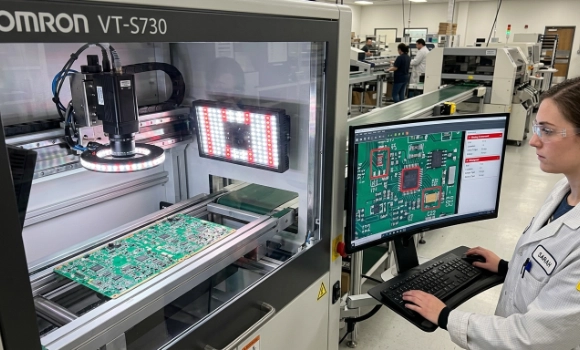
2. PCB Positioning
The PCB is placed in the laser machine.
Vision systems or fiducial alignment ensure accurate positioning before marking.
3. Laser Generation
A laser source generates a high-energy beam of light, which is focused onto the PCB surface.
4. Material Interaction
The laser interacts with the material in different ways:
- Engraving → removes material
- Etching → modifies surface texture
- Color change → creates contrast without removing material
This interaction forms visible marks on the PCB surface.
5. Mark Formation
The laser beam is guided precisely (via mirrors or scanners) to create:
- Text
- Codes
- Patterns
The result is a high-resolution, permanent mark.
6. Inspection and Verification
After marking, systems verify:
- Readability (barcode/QR scanning)
- Position accuracy
- Contrast quality
Automated inspection ensures 100% traceability compliance.
Integration into PCB Assembly Process
Laser marking is typically integrated into SMT or PCBA lines:
- Before component placement
- After reflow soldering
- After final assembly
Inline systems allow real-time marking without interrupting production flow, improving efficiency and reducing handling.
Common Applications of PCB Laser Coding
Laser coding enables advanced manufacturing control:
- Product traceability (serial tracking)
- MES system integration
- Anti-counterfeiting identification
- Quality control and recall management
Data Matrix codes are especially popular due to their high data density in small areas.
Advantages of PCB Laser Marking
1. High Precision
Supports micro-scale marking on compact PCB designs
2. Permanent and Durable
Marks survive reflow, cleaning, and harsh environments
3. High Efficiency
Fast processing suitable for high-volume production
4. Cost Reduction
No consumables like ink or labels
5. Improved Traceability
Enables full lifecycle tracking of each PCB
Conclusion
PCB laser marking and coding have become essential technologies in modern electronics manufacturing. By enabling precise, permanent, and machine-readable identification, they support traceability, quality control, and automated production systems.
Ready for Production? Kickstart Your Project Now. info@ysx-tech.com
Unsure About the Design? Consult with Our Lead Engineers Today. contact us
Share on Social:


